



- Project Management
- Intelligent Buildings
- BREAM
Scope
The initial driver for this project came from Booking.com's rapid growth and success in recent years. Expanding quickly, they already held several offices across Amsterdam. But this was creating operational challenges – creating silos and making collaboration more difficult. The offices themselves were hidden away from the tourist centres where Booking.com wanted to be seen as active members of their community.
They set out with a question – can we bring all 7,000+ of our employees under one roof?
With existing office space in Amsterdam either limited or unable to meet the needs of their size, their question soon shifted – can we build the office that would bring all our employees under one roof?
This reassessment presented new challenges, and opportunities. Booking.com had never built their own office – they'd always brought their fit-out to an existing space. Here, they would need to create an office flexible enough at its core to adapt to the needs of their current staff, and the staff of the future.
The chance also opened new doors of potential – to elevate and accelerate their sustainable initiatives and create a bespoke space that could serve communities beyond their own staff.
But they would need experience and expertise to make it happen. That's where we came in.
Approach
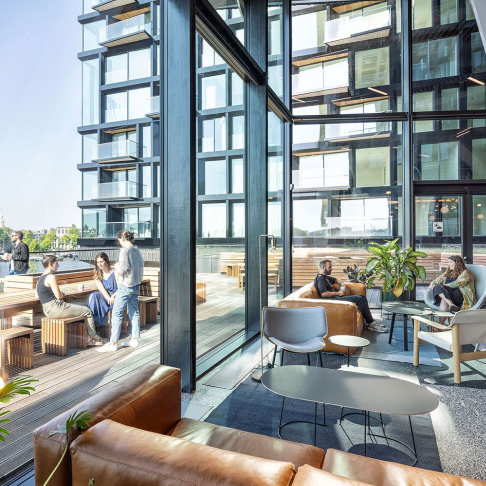
Our role began at the earliest stage as the experience of our Real Estate team helped Booking.com's own real estate team establish the internal processes and approval lines that would ensure smooth progress and alignment on such a large-scale project. The completed building is the largest single-use building in Western Europe.
Central to our collaboration was the creation of an ambitious, flexible programme of requirements (PoR). It would become the bible of the project – laying out design objectives, constraints and criteria, space requirements, quality levels, flexibility and expandability, and more.
Here, we helped bridge the gaps between the expectations of the developer responsible for the land on which the office would stand; and Booking.com's desire for the flexibility to make changes to the design. Allowing the final building to be fit for the very latest wants and needs of its staff.
Outcome
In developing the programme of requirements, we helped Booking.com understand what they wanted from the building. The company operates within agile frameworks day-to-day, with digital ways of working allowing different teams to interact and work together with speed and adaptability.
We encouraged Booking.com to build on these smart and agile ways of working, using the physical workplace to promote the building of ideas across silos. Despite their digital workflows, being spread across Amsterdam before, Booking.com's tech environment was separate from their software, or from their marketing.
With a building that encouraged interactions – both deliberate and chance – we knew that Booking.com's proposition to employees and customers would improve.
What resulted was a flexible, future-ready programme of requirements – ready for the challenges, changes and opportunities of the project that lay ahead. The strength of our collective work in those early stages was proved when the pandemic struck in the midst of the project.
Despite the overhaul of working norms that resulted – we didn't have to change course drastically at any point in the build or design. Our plans were already flexible – and had been designed with future workplace visions in mind.